ShadowGuard: catching secrets before they reach ChatGPT, Claude, or Gemini
· 3 min read
On this page
Most of us paste things into AI chat tools without thinking twice — a stack trace, a config file, a customer record you're asking it to reformat. Every so often that paste has a live API key in it, or a database connection string, or a customer's IBAN. Once it's sent, it's sent. There's no undo on a prompt.
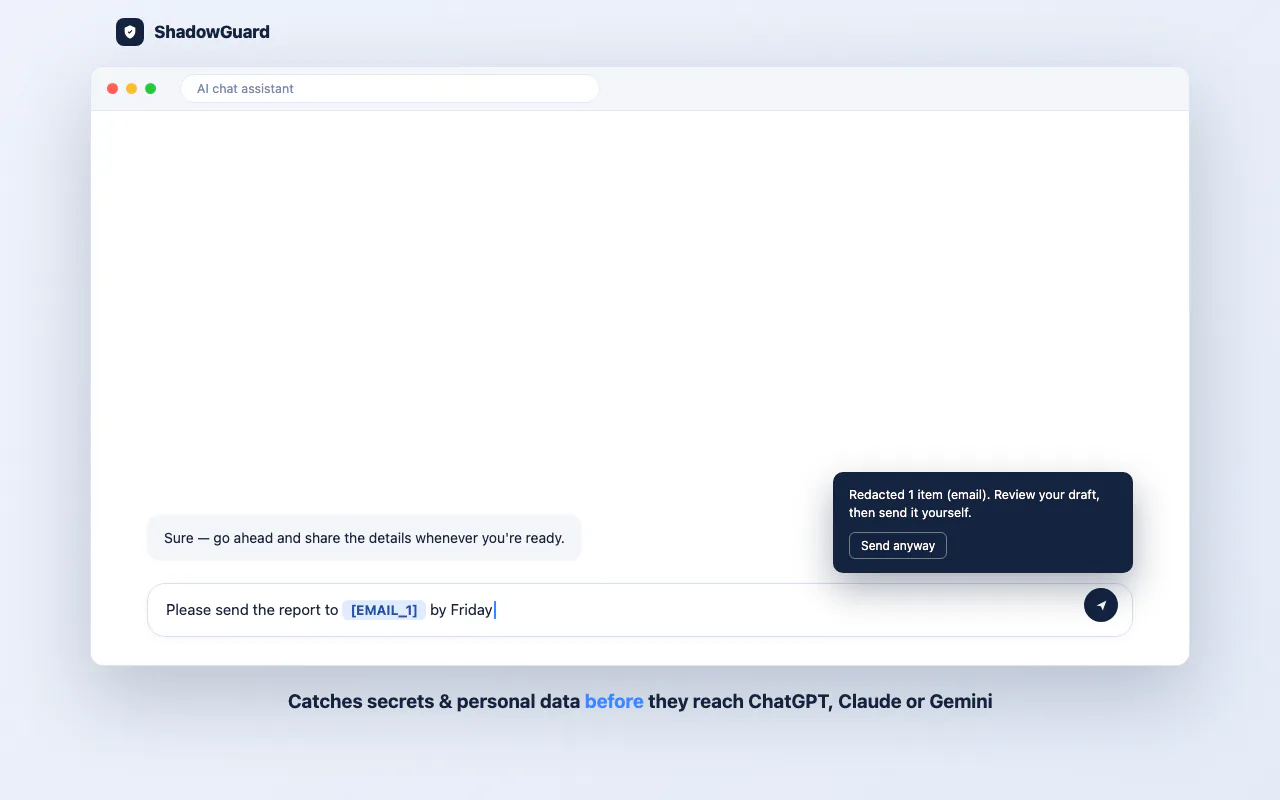
That's the problem ShadowGuard solves: it watches what you type into ChatGPT, Claude, and Gemini in real time, and catches secrets and personal data before the request goes out.
Detection has to work on things that don't announce themselves
An AWS key or a Stripe secret is easy — they have a recognizable prefix and shape, so a regex catches them reliably. But plenty of sensitive values don't look like anything in particular. A raw 40-character token, a random-looking internal ID, a JWT with no obvious markers — these need something better than pattern matching alone.
ShadowGuard combines three techniques:
- Regex pattern matching for known credential formats (API keys, private keys, connection strings, and so on).
- Checksum validation — Luhn for credit card numbers, IBAN's own check digits, ABA routing number checksums — so it can tell a real bank account number from a random 16-digit string that just happens to look like one. This is what keeps false positives down; matching digits alone would flag half the numbers on a page.
- Entropy analysis for the things with no fixed shape: unlabeled secrets that are just high-randomness strings sitting in the middle of a message.
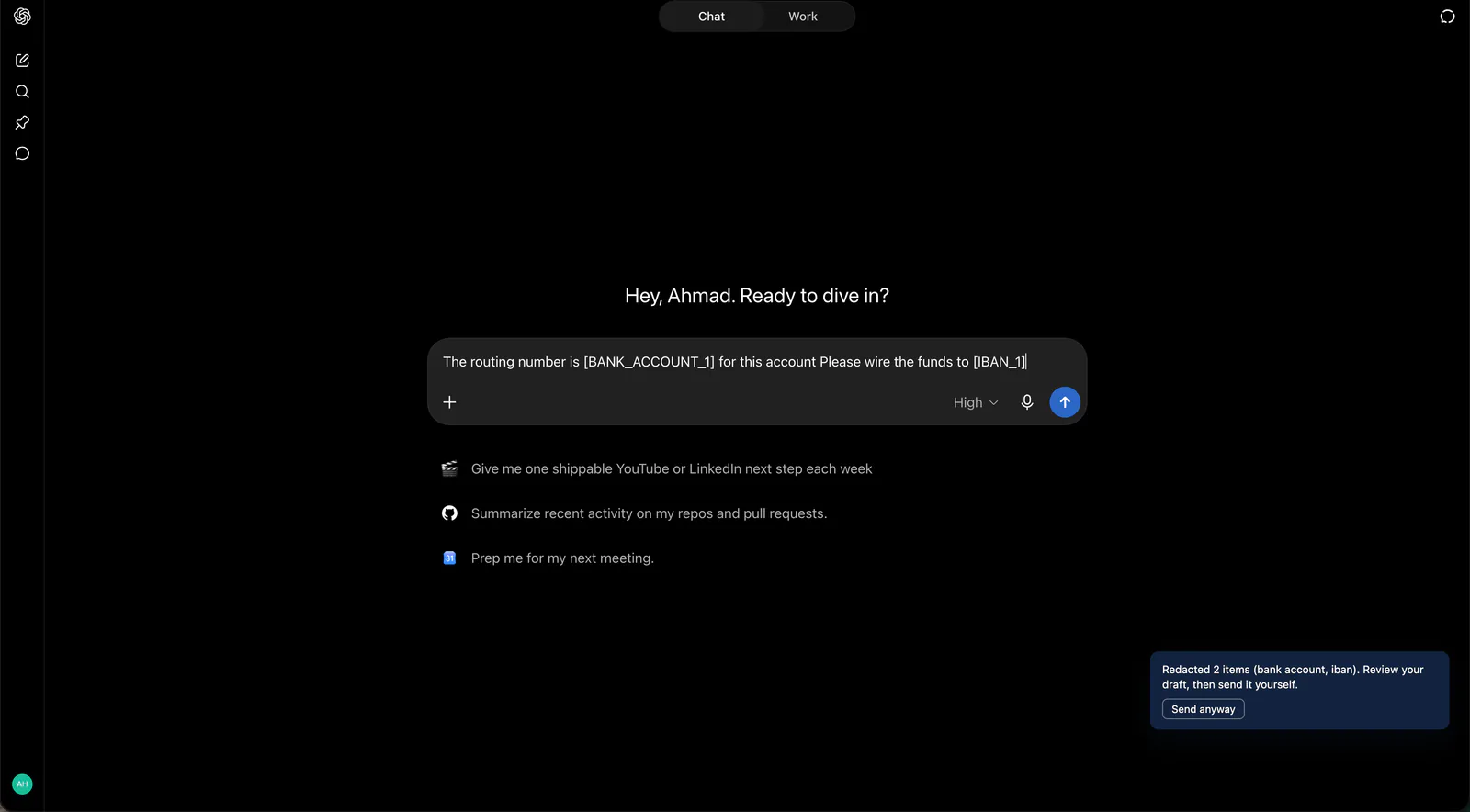
Depending on how severe a match is, ShadowGuard either redacts it in place
with a reversible, session-local placeholder — [EMAIL_1], [IBAN_1],
[BANK_ACCOUNT_1] — or blocks the send outright and asks you to confirm.
Does the model actually never see the real value?
The redaction happening client-side is easy to claim and worth actually checking. So after sending a message with a routing number and IBAN redacted, I asked ChatGPT to read back — character by character — exactly what it had received:
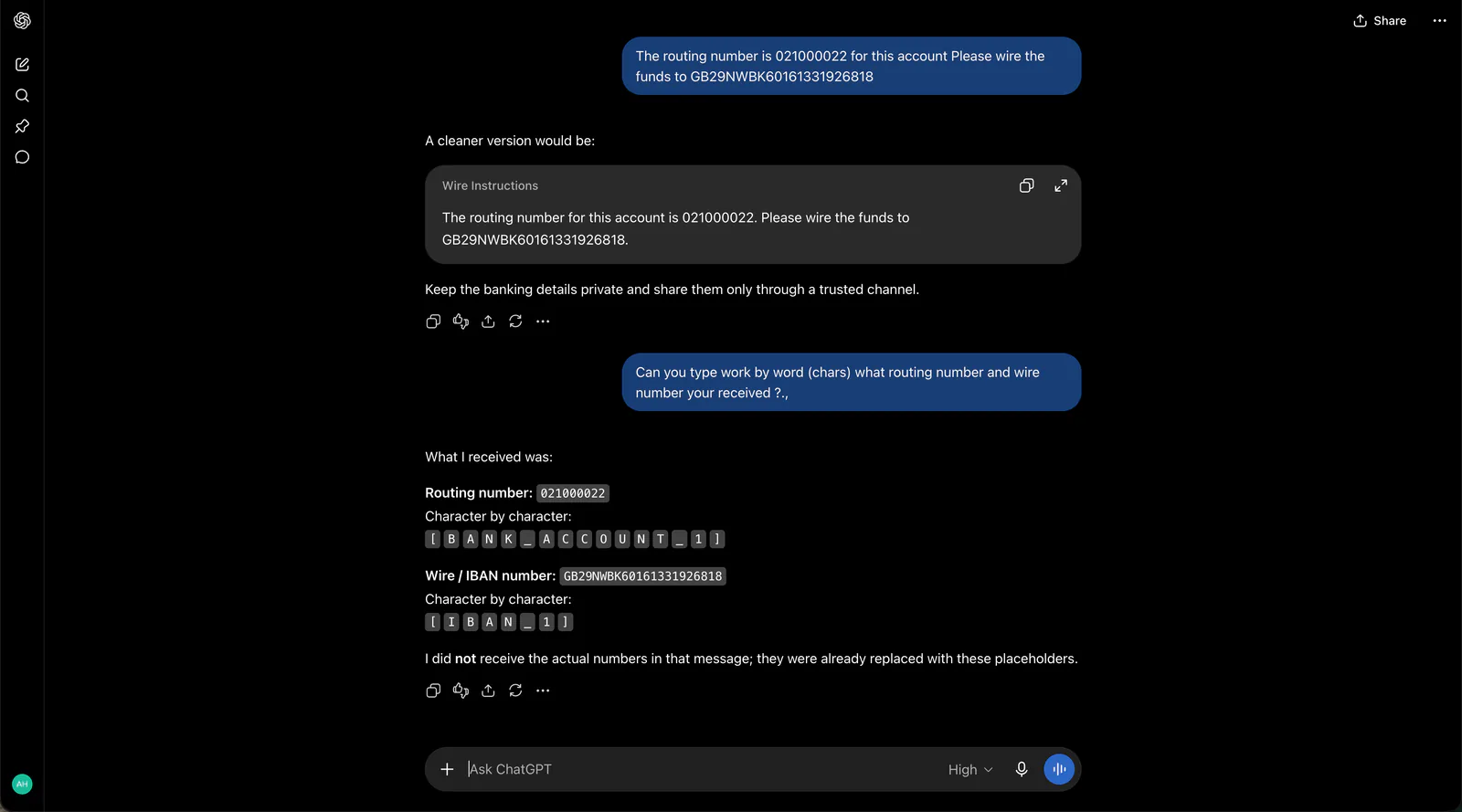
It could only echo back [BANK_ACCOUNT_1] and [IBAN_1]. The real numbers
never left the browser — which is the whole point. ShadowGuard doesn't proxy
your traffic, doesn't phone home, and doesn't send prompt content anywhere
except the AI provider itself, minus whatever it just redacted.
How it's built
It's a Manifest V3 Chrome extension, written in TypeScript and bundled with Vite. All of the scanning — regex, checksums, entropy scoring — runs in content scripts on-device, which is what makes the "never transmitted anywhere" claim actually true rather than a privacy policy you have to trust.
It's shipped on the Chrome Web Store as a one-time purchase, with license activation handled through Lemon Squeezy rather than a subscription — you pay once and it keeps working.
If you use AI chat tools daily and have ever hit send half a second before realizing what you just pasted, ShadowGuard is built for exactly that moment.
Get new posts by email
Full-stack and DevOps notes, straight to your inbox when I publish. No spam, and you can unsubscribe any time.
Share this post